What needed solving
The base and side regions of refrigerator internal panels require verification for the required holes and their formation before downstream assembly.
Manual inspection makes it difficult to apply the same count and feature criteria consistently across panel geometry and shifts.
How Qualitas solved it
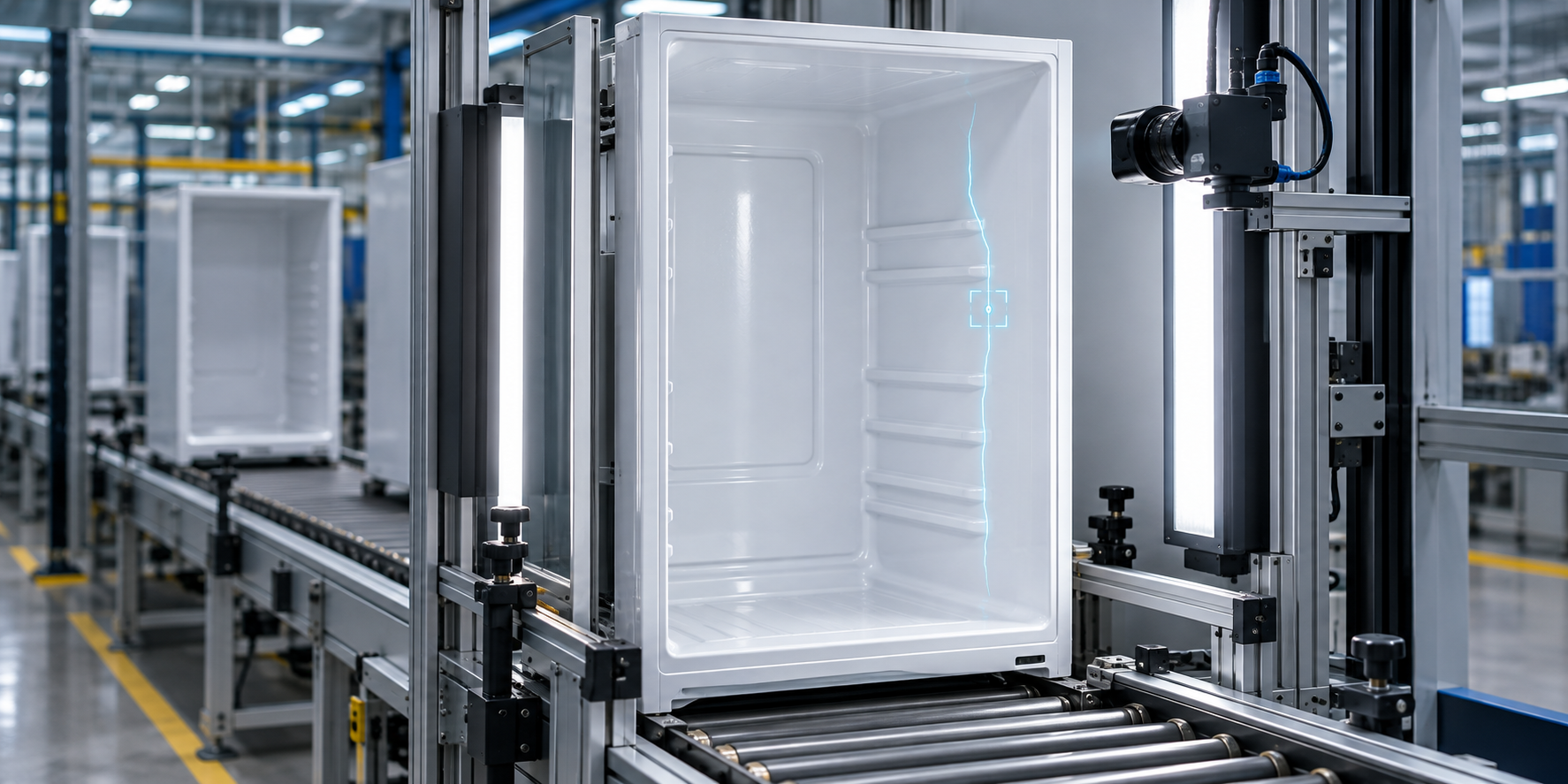
A controlled camera-and-lighting station captures the selected panel regions and applies a part-specific inspection recipe for presence, count, and feature validation.
Each inspection can retain a result and supporting image for review, enabling an agreed exception workflow rather than relying on an unauditable visual check.
Inspection Requirement
The scope was verification of holes in the base and side regions of a refrigerator internal panel. The check needed to establish whether the intended features were present, whether the count matched the selected part recipe, and whether the visible formation met the agreed inspection rule.
| Inspection check | Purpose |
|---|---|
| Hole presence | Confirm that each required feature is visible in its expected region |
| Hole count | Compare the observed count against the correct panel recipe |
| Feature formation | Flag visible deviations for review according to the agreed acceptance criteria |
Machine-Vision Method
The inspection concept uses controlled image acquisition at a defined station. A locating method presents the selected panel regions repeatably; lighting is tuned to make relevant feature edges distinguishable; and the software applies the correct inspection recipe for the variant.
- Camera position and lighting are validated against representative panel finish, geometry, and feature contrast.
- A recipe links each variant to expected regions and the required feature count.
- The result can be sent to an operator screen or line control with the retained inspection image for exception review.
Validation and Operational Handover
Because cycle time, sample variation, and acceptance limits are installation-specific, production performance is not stated here. A complete project validates the inspection against an agreed labelled sample set, confirms line handling and interface behavior, and defines the escalation process for uncertain or failed results.