The Inspection Challenge
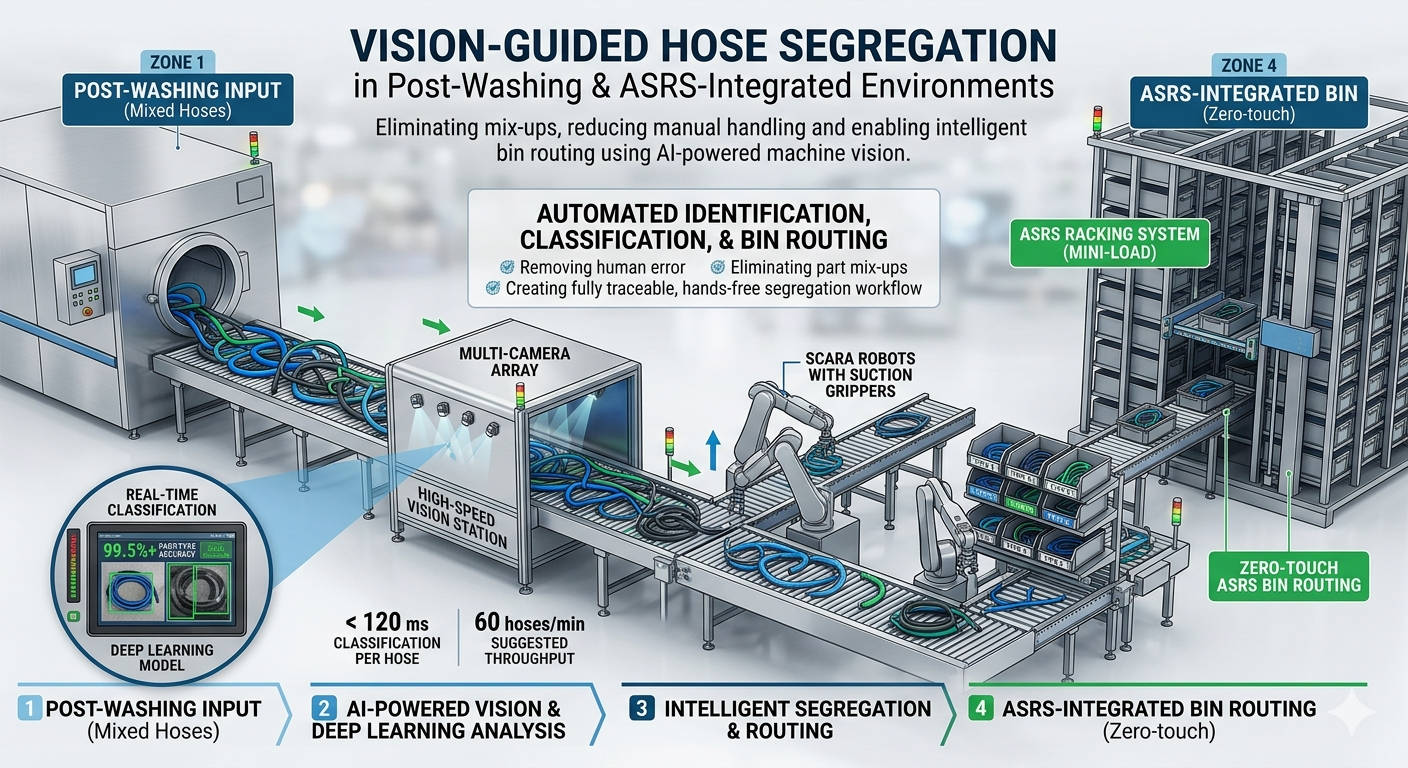
Automotive hose assemblies — coolant, fuel, vacuum, brake, and power-steering lines — are often washed and dried in mixed batches, because upstream moulding and assembly cells run several part numbers in parallel. Downstream automated storage and retrieval (ASRS) systems need each hose correctly identified and routed to its assigned bin before putaway, and a mis-sorted hose typically stays invisible until it is pulled for a build and turns out to be the wrong part.
| Challenge Area | Why it matters |
|---|---|
| Mixed-batch post-wash flow | Multiple part numbers arrive intermixed on the same conveyor with no automatic separation step. |
| Near-identical part geometry | Several hose variants in a family can share outer diameter and length within a few millimetres — difficult to judge reliably by eye at speed. |
| Wet-part colour coding | A water film on the hose surface shifts how stripe and jacket colours read to both the human eye and a camera sensor. |
| Safety-critical part mix | Brake and fuel lines are typically controlled parts under the OEM's own PPAP/control-plan requirements, so a wrong-part event on these lines carries more consequence than on a non-critical line. |
Why Traditional Methods Fall Short
Human inspectors are the default sorting method on most post-wash lines, and published human-factors research on industrial visual inspection is a useful reality check on what to expect from that approach: peak detection performance for a single trained inspector tops out at roughly 80%, rising to around 96% only when a second inspector independently reviews the same parts, and documented accuracy starts degrading within the first 20–30 minutes of a repetitive sorting task — well before fatigue is subjectively noticeable to the inspector. None of this is specific to hoses, but the same dynamics apply to any fast, repetitive task of telling near-identical parts apart.
| Method | Limitation in a post-wash environment |
|---|---|
| Manual visual sort | Subject to the fatigue and attention effects above; unaided judgement of a sub-5 mm OD difference is unreliable at line speed. |
| Barcode / QR scanning | Labels are frequently wet, torn, or missing after a wash cycle, and an unreadable label stops the line rather than sorting around it. |
| Colour chart comparison | A water film measurably shifts perceived stripe colour under ambient light, defeating a fixed reference-chart comparison. |
| Dimensional hand gauging | Contact measurement at conveyor speed is both unsafe and too slow to keep pace with wash-line throughput. |
| Weight sorting | Hose variants from different part numbers can fall inside the same weight tolerance band, especially with residual wash water on the part. |
| Operator batch declaration | Relies on paperwork discipline rather than a per-unit check, so it cannot catch a single misrouted hose inside a batch. |
Suggested Machine Vision Architecture
Two area-scan cameras — one overhead, one lateral — under structured LED illumination image each hose as it exits the wash step. A convolutional neural network trained on the customer's own part catalogue processes both views to infer part type, outer-diameter category, length range, colour-stripe pattern, and visible surface condition. Published deep-learning studies on manufacturing and produce-sorting classification tasks report accuracies typically ranging from the low-90s to 99%+ depending on how visually distinct the classes are and how much labelled training data is available — that range is a starting expectation, not a guarantee, and the achievable figure for a specific hose family is established during a feasibility study on real parts, not assumed upfront. Results publish over OPC-UA — the vendor-neutral OPC Foundation/VDMA companion specification for machine vision (OPC 40100) — so SCADA and ASRS controllers on different platforms can consume the same result stream without a custom point-to-point integration.
| Detection Parameter | Method | What the achievable number depends on |
|---|---|---|
| Part-type classification | CNN trained on the customer's part catalogue | Visual distinctiveness between part numbers and the size of the labelled training set; confirmed on real parts during feasibility. |
| Outer-diameter category | Calibrated dual-view metrology | Camera resolution and working distance relative to the OD difference being distinguished. |
| Hose length range | Pixel-count metrology, camera-calibrated | Conveyor-plane calibration accuracy and part curvature or coiling at the point of capture. |
| Colour stripe pattern | Colour vision under a controlled LED spectrum | Consistent illumination and compensation for the wet-surface colour shift described above. |
| Kink / crush defect | Contour and shape-anomaly analysis | How different a kink silhouette is from normal part flex within the sample set. |
| Surface mark or cut | Anomaly-detection deep learning trained on known-good samples | Contrast between the mark and surrounding surface texture under the chosen lighting. |
Expected Outcomes & ROI
The defensible case for vision-guided sorting isn't a single invented accuracy percentage — it's removing fatigue and per-shift variability as the weak link between "correctly washed part" and "correctly binned part." AS/RS installations are commonly reported to reach 99.9%+ inventory accuracy industry-wide, but that figure describes the storage and retrieval system itself; it assumes correctly identified stock reaches the bin in the first place, which is exactly the step this note addresses. Separately, independent recall-cost research puts the average direct cost of a vehicle recall at roughly USD 500 per vehicle affected — a figure that scales quickly once a wrong-part event is traced back through a production run rather than caught at the point of sort.
| Outcome Area | What manual sorting is documented to produce | What vision-guided sorting is designed to change |
|---|---|---|
| Sort consistency | Peak individual accuracy of roughly 80% (about 96% with a second reviewer), degrading further within 20–30 minutes of repetitive work | A trained model applies the same classification criteria to every hose, on every shift, without fatigue. |
| Traceability | Typically batch-level paperwork, with no per-unit record | A per-hose classification result, image, and timestamp published to SCADA/ASRS for every unit. |
| ASRS bin-accuracy dependency | The system's own 99.9%+ accuracy figure assumes correct identification on the way in | Removes mis-identification as the practical ceiling on that figure. |
| Recall cost exposure | Industry data puts average per-vehicle recall cost at roughly USD 500, scaling with recall volume | Reduces — does not eliminate — the chance a mis-sorted safety-critical hose reaches a build; the achievable reduction should be sized against your own historical mis-sort and recall data. |
Payback periods for machine-vision sorting retrofits are commonly cited in the one-to-two-year range across manufacturing case studies, but the number for your line should be modelled from your own labour cost, mis-sort frequency, and recall exposure during feasibility, rather than assumed from a generic industry figure.
Implementation Considerations
A phased rollout — feasibility sampling against your real part mix with class-by-class confidence reporting, then a pilot on one line with manual override, then full ASRS/WMS integration — lets you validate accuracy before committing to a fixed specification. The number of visually similar hose variants in your own catalogue, not a generic industry figure, is what actually determines classifier accuracy and how long each phase should run.