
The Inspection Challenge
Counting cigarette buds by hand means physically touching each roll — direct contact that risks contaminating the product and can deform the roll or its filter end. On a tray holding several thousand rolls per cycle, that makes manual counting both a product-handling risk and a pace the line cannot sustain.
Tobacco track-and-trace regulation has also moved past voluntary recordkeeping. The WHO Framework Convention's Protocol to Eliminate Illicit Trade in Tobacco Products (in force since September 2018) requires a unique, secure identifier on every unit packet, tying it back to manufacturer, market, and tax status. India has since layered its own mechanism on top: a CGST Act Section 148A track-and-trace requirement, rolling out first for cigarette packs, aimed at a domestic illicit cigarette market industry estimates put at roughly a quarter to a third of legal volume. A tray count that is not tied to a specific tray, SKU, and timestamp is a gap against both regimes, not just an internal quality question.
| Risk | Business Impact |
|---|---|
| Physical handling risk | Manual counting means touching each roll — contamination and roll/filter deformation risk affecting product functionality |
| Assumed, not verified, counts | Every tray ships on a nominal fill assumption, not a measured one |
| Under/overfilled cartons downstream | Pack-out errors surface only after material is already boxed |
| No batch-level audit trail | Manual counts cannot be traced back to a specific tray or shift |
| Regulatory exposure | WHO FCTC and India's CGST track-and-trace mechanism both expect a verifiable, logged identifier per unit — not a spot-check estimate |
Why Traditional Inspection Falls Short
Manual counting is not really an option for a tray holding several thousand items. It requires direct handling, provides no image-backed evidence trail, and runs into a well-documented limit of sustained visual attention rather than a per-worker skill problem. The vigilance-decrement literature — dating to Mackworth's original 1948 studies and replicated many times since in human-factors research — consistently finds detection accuracy on monotonous visual-monitoring tasks drops measurably within the first half hour on watch, before declining further. Tray counting at line pace is exactly that kind of task, even though it has not itself been the subject of a dedicated published study.
| Limitation | Why It Matters Here |
|---|---|
| Direct handling required | Needs to stay sanitary and be handled delicately — impractical to guarantee by hand |
| Speed vs. volume | A tray holding several thousand items is not practically hand-countable at line pace |
| Attention, not just effort, decays | Vigilance research shows detection accuracy on monotonous visual tasks falls within the first 30 minutes, independent of operator diligence |
| No data trail | A verbal or written count cannot be traced back to an image or a specific tray |
The Machine Vision Approach
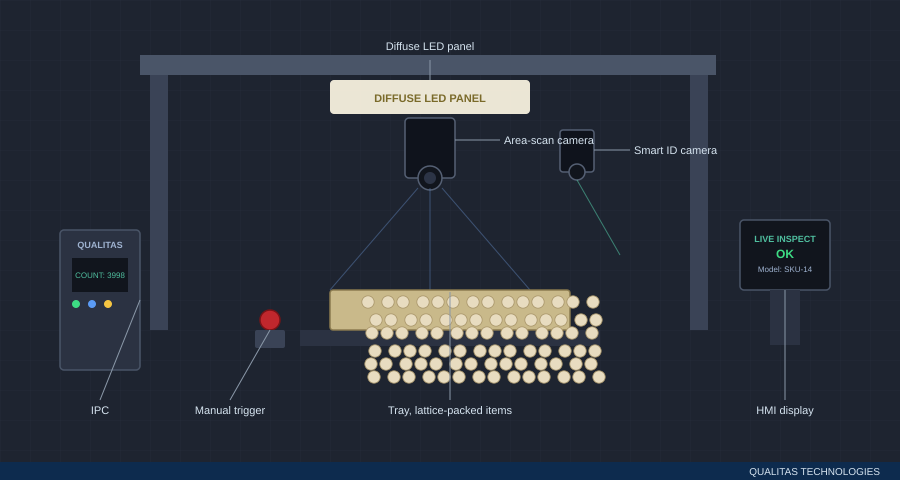
The proposed approach is a single inspection station that captures the full tray in one image, identifies the tray/SKU, and counts the buds within a cycle-time target set during the pilot. Every cycle produces an image-backed result that can be reviewed and audited later.
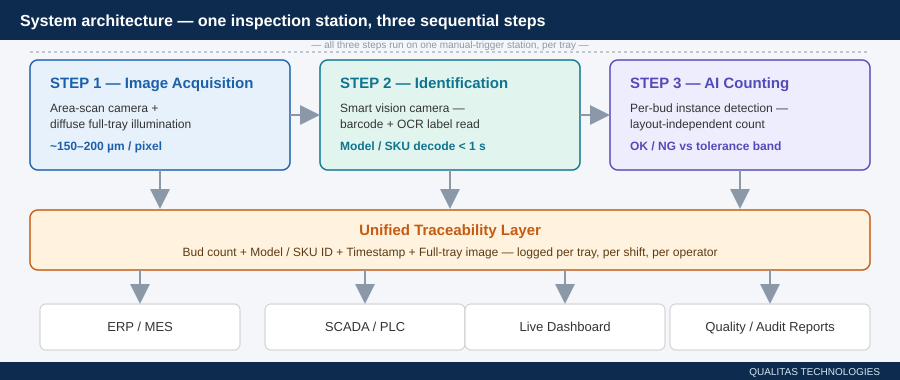
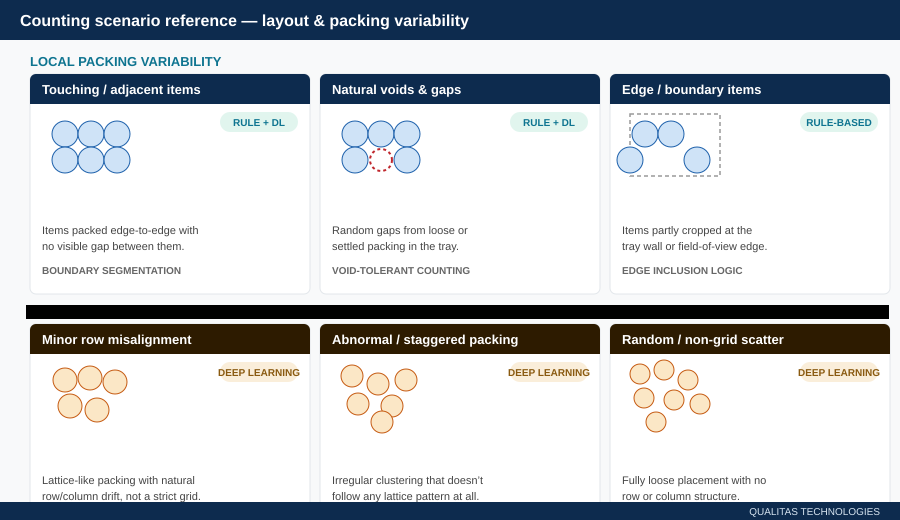
The system uses a high-resolution camera over the tray with diffuse illumination, a compact smart camera for barcode/OCR identification, and a deep-learning model that detects and counts individual buds directly rather than relying on a fixed grid or template. This density-map style of counting is an active research area for exactly this kind of densely packed, visually uniform object: a 2026 study on counting machined parts by this method reported a mean absolute error near two items per image on its benchmark set — evidence the underlying technique is capable of industrial-grade precision, though the figure is specific to that dataset and object geometry, and accuracy on cigarette buds has to be established on the customer's own trays during the pilot, not assumed from a published number.
Expected Outcomes & ROI
Count tolerance and cycle time are engineering targets, not delivered facts — they get fixed during Phase 1 piloting, where the system's count is checked against a manual recount baseline on the customer's actual trays and packing patterns before anything is signed off. What the architecture reliably changes, regardless of where those targets land, is the shift from an assumed fill number to a measured one with an image and timestamp behind it.
| Metric | Before → After |
|---|---|
| Count verification | Assumed → measured every tray, against a tolerance band fixed during pilot validation |
| Cycle time per tray | Not measured / bottleneck → a single trigger-to-result target set and validated per line |
| Audit trail | None → full image + count + model ID + timestamp per tray |
| SKU / model linkage | Manual, error-prone → automatic, decoded at point of count |
| Scalability across SKUs | New SKU adds manual variability → same model architecture applies across SKUs, given comparably uniform bud geometry |
The broader counting-and-inspection machinery market this kind of station sits in was sized at roughly USD 2.24 billion in 2026 for high-speed counting machines alone, growing at an estimated 11.4% CAGR — context for why count-verification stations are increasingly a standard line addition rather than a bespoke one-off.
Implementation Considerations
Because cigarette-bud geometry is comparably uniform across SKUs, the same trained model is expected to generalize across the portfolio with relatively few sample images per new SKU — a claim the pilot phase should confirm rather than assume. The rollout scales by deployment footprint: pilot, integrate the data, then replicate.