The Quality Gap Before the Carton Closes
Estimates of India's packaged drinking water market vary widely by methodology — IMARC Group put the broader bottled water market at roughly USD 9.5 billion in 2024, trending toward a double-digit CAGR through the early 2030s, while other research firms model the same market at a materially different size. What doesn't vary between reports is the operational reality on a regional bottler's floor: accumulation conveyors between capper and packing station commonly run anywhere from the tens up to 150-plus bottles per minute, with dedicated capping heads rated for several hundred caps per minute. That conveyor is the last inspection opportunity before a sealed carton leaves for retail. The capper's torque sensor confirms tightening force — it has no way to see a skewed thread, a wrong-colour cap left over from a batch changeover, or a hairline crack.
| Method | Limitation | Impact at Packing Gate |
|---|---|---|
| Torque / Capper Sensor | Confirms capping force only — no visual check for angle, colour, or post-cap damage | Skewed and wrong-colour caps pass undetected |
| Photoelectric Beam Sensor | Binary presence/absence only; no classification | Counts bottles but cannot flag any cap defect type |
| Manual Spot-Check | Operator samples a small fraction of bottles at reduced attention for extended stretches of a shift | Systematic defects can persist into carton packing between checks |
| Weight-Based Carton Check | Fill-tolerance bands are typically wide enough that a single missing cap can sit within the checkweigher's noise floor | Missing-cap bottles can pass as correctly packed |
| End-of-Line Sampling | Opening sealed cartons after packing to re-inspect is not economical at scale | A defect caught after packing costs materially more to correct than one caught before the carton closes |
Why a Sensor-Only Line Can't Close the Gap
The weakness in manual spot-checking isn't a fixed accuracy ceiling so much as attention that erodes with repetition and time on task. Published Sandia National Laboratories research on precision-manufactured parts — also cited in Qualitas' automotive inspection notes — found inspectors correctly rejected 85% of defective items while also incorrectly rejecting 35% of acceptable ones in that specific study; the study itself cautions against treating the figure as a universal inspection benchmark. The more defensible case for an inline vision check at a bottling line isn't a claimed accuracy percentage — it's that a camera applies the same check, at the same threshold, to every bottle, on every shift, regardless of fatigue.
- A photoelectric beam or capper torque sensor can confirm presence or tightening force, but neither can classify what it sees — so colour, angle, and surface condition are checks a sensor alone cannot make.
- Manual spot-checks sample a fraction of production; the bottles between checks receive no inspection at all.
- Batch changeovers are a known failure window — a wrong-colour cap left in the hopper is a visual defect, not a torque or weight anomaly.
- None of these methods produces a timestamped, per-bottle image record — only a pass/fail signal or a paper log entry.
AI Video Analytics Approach
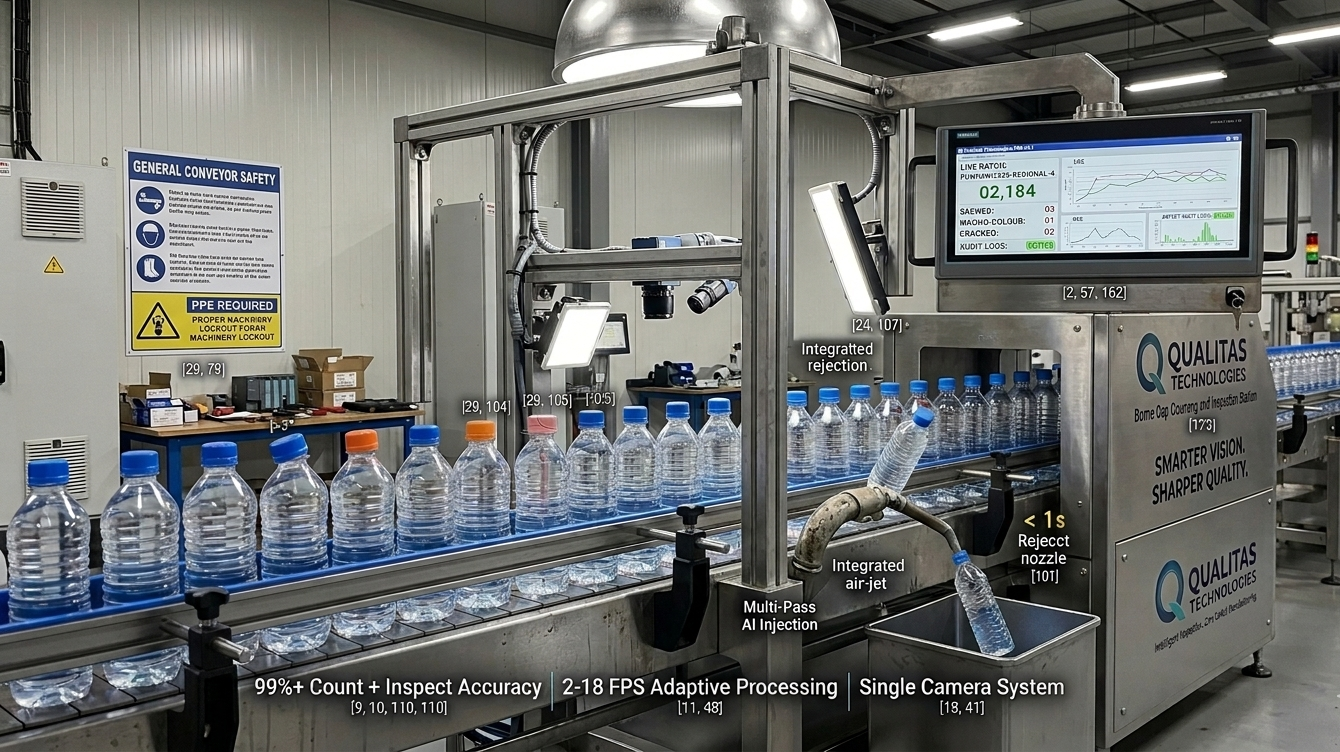
Qualitas deploys an overhead industrial camera with a diffuse dome LED illuminator above the accumulation conveyor, feeding a YOLO-family object-detection model on an edge IPC. Count and defect classification happen in a single forward pass per frame rather than as two separate checks. The operating frame rate is tuned to line speed and camera resolution during commissioning rather than fixed in advance — published benchmarks for YOLOv8-class models on edge hardware span roughly single digits to around 30 FPS depending on model size and compute, which is the practical range this kind of station is designed within.
The detection model outputs per-frame class labels — good cap, missing, skewed, cracked, wrong-colour — against each bottle in a virtual count line. A confirmed count event fires as each bottle crosses the line, with its class label logged alongside it. A defect event triggers a fast air-jet or divert-gate reject signal over the customer's existing PLC interface, removing the flagged bottle before it reaches carton loading.
| Detection Scenario | Technical Approach | Design Intent |
|---|---|---|
| Missing cap | Absence detection — no cap-class bounding box within the bottle region of interest | Near-elimination of missed-cap escapes; validated against the customer's own defect samples during commissioning |
| Skewed / tilted cap | Bounding-box aspect ratio plus angle estimation from the cap contour | Reliable flagging at the skew angles the customer defines as defective, confirmed on production samples |
| Wrong-colour cap | Colour histogram combined with a per-class classifier in the same inference pass | Fast alarm on batch-changeover colour mismatches, tuned to the customer's actual cap-colour set |
| Cracked / damaged cap | Edge detection and segmentation on the cap surface region | Sensitivity threshold set against the smallest crack width the customer's quality standard requires |
| Count mismatch | Virtual count line with per-bottle track-ID persistence | Count accuracy validated against the line's actual speed range at commissioning |
| Batch changeover error | Wrong-colour class triggers a colour-mismatch alarm tied to batch ID | Alarm within a small, fixed number of bottles of the first mismatch — confirmed per line |
| Reject signal | Fast PLC output compatible with air-jet or divert-gate actuation | Reject latency validated against the specific PLC platform on site (e.g. Siemens S7, Allen-Bradley ControlLogix) |
Expected Outcomes & Return on Investment
The case for this system rests on closing a gap that sensors and sampling structurally cannot close, plus the auditable record that comes as a byproduct: a continuous, per-bottle check with an image tied to a timestamp and, where relevant, a batch ID. FSSAI's revised Scheme of Testing for Packaged Drinking Water and Mineral Water — mandatory from 1 January 2026 under the Food Safety and Standards (Packaging and Labelling) Regulations, 2011 framework — pushes bottlers toward exactly this kind of batch-wise, retrievable evidence rather than paper logs. Actual escape-rate reduction, payback period, and return rate impact are line-specific and depend on current defect rates, product mix, and shift patterns; these should be modelled against the customer's own production data rather than a generic industry figure.
| Outcome Area | Before | With Qualitas AI System |
|---|---|---|
| Cap defect escapes | Depends on current sensor/sampling regime and shift discipline — typically not directly measured today | Continuous, per-bottle check in place of periodic sampling |
| Count accuracy | Beam-sensor presence counting, no classification | Count and defect class captured together, with a per-bottle image record |
| Wrong-colour catch rate at changeover | Limited to whatever fraction of bottles a manual spot-check covers | Every bottle checked; alarm fires within a small number of bottles of the first mismatch |
| Traceability / audit readiness | Manual paper logs, generally without image evidence | Timestamped image archive per shift, exportable — supporting FSSAI's revised batch-record expectations |
| Capper wear detection | Reactive — typically noticed only after a complaint or rework spike | Proactive — a rising skew-defect trend can flag capper maintenance before it becomes a complaint |
| Payback period | Not applicable | Line- and volume-dependent; modelled from the customer's own defect and volume data, not a fixed industry number |
Implementation Considerations
A representative hardware footprint for this kind of station is a single edge AI IPC, one industrial GigE camera, and a dome LED panel — compact enough to mount over an existing conveyor without a line rebuild, in a stainless-steel, washdown-rated enclosure suited to food and beverage environments. Exact camera resolution, working distance, and enclosure rating depend on bottle size, conveyor width, and the site's hygiene requirements, and should be confirmed during a feasibility review rather than assumed upfront.